How Does a Child Support Calculator Work?
A child support calculator estimates how much one parent must pay the other by applying a statutory formula. Key inputs are parent incomes, custody arrangements, and the number of children.

The calculation method differs depending on whether the state uses an income shares or income percentage model. We compared child support calculators across states and nations to see how they work. While every calculator is unique because formula details vary, the basic steps are often the same.
How Child Support Calculators Work Step by Step
The most common step-by-step method for calculating child support is an income shares method. The core set of steps are:
- Calculate each parent’s net income after deductions for eligible expenses such as self-support.
- Combine the two incomes to estimate the family’s total available income.
- Use a state guideline table to estimate the cost of raising the children at that income level.
- Divide the obligation between the parents according to their percentage of the combined income.
- Adjust the result by giving financial credit for parenting time.
In researching this article, we spoke to Dr Andrew Lancaster, a child support researcher who constructed an online child support calculator for Australia. Dr Lancaster says parents who are new to child support often assume the systems are standardized, so you should be able to look up or easily calculate how much you pay or receive. "Actually, most systems are complicated. Estimates are often sensitive to changes in income or custody."
Information Child Support Calculators Ask For
A child support calculator asks for the details needed to apply the state formula. The exact questions vary, but most calculators need similar core inputs before they estimate a payment.
- Parent incomes: wages, salaries, bonuses, self-employment income, benefits, and other regular income.
- Deductions: taxes, mandatory retirement payments, union dues, existing support obligations, and health insurance costs.
- Children: the number of children covered by the calculation.
- Custody split: annual overnights, parenting-time percentage, or another measure of care.
- Extra costs: childcare, medical insurance, dental costs, and sometimes educational expenses.
Parents often have questions like “if I make $1,000 a week how much child support do I pay?” However, it usually doesn't work that way. The calculator also needs the custody split and the number of children, because those inputs are part of the formula. Dr Lancaster says an income percentage model is simpler because you just take a percentage of the payer's income as the child support amount, with the percentage higher if more children are involved. "The UK takes the simpler approach, as do states such as Alaska, Mississippi, Nevada, North Dakota, Texas, and Wisconsin."
How Income and Custody Work Together
Most child support calculators combine income and custody using a three-element relationship: Basic idea: income share adjusted for parenting time = estimated child support payment Under the Income Shares Model, parent incomes are combined first. Each parent is then assigned a percentage of the child’s estimated costs based on their share of combined income. An adjustment is also made for parenting time. Dr Lancaster says many parents assume equal custody means no child support. "But it doesn't work that way under the income shares model. The parent with the higher income will be required to pay because their income share is greater."
Why Overnight Care Changes the Result

Child support formulas usually treat overnight care as a financial contribution by the parent caring for the child. More overnight care generally means more spending on food, housing, transport, supervision, and daily living costs.
- Few or no overnight visits often lead to higher child support payments.
- Shared custody can reduce the support obligation.
Dr Lancaster says overnight care is normally part of the formula and calculator design. "You can think of child support as one parent paying the other for doing more of the parenting. The cleanest way to measure that difference is by comparing how many overnights a child spends with each parent." Michigan’s Friend of the Court formula, for example, incorporates overnight parenting time into the calculation. Even modest changes to overnight schedules can alter the payment estimate.
Why Calculator Results Are Estimates
A free child support calculator is designed to estimate what the official guidelines may produce, but the result should normally be treated as indicative only. The estimate may be off due to simplifications to the official formula. Some calculators are flawed because the lawyer or finance person who created them made mistakes. Missing or inaccurate information are further issues. Judges also have authority to adjust support amounts when unusual circumstances exist or when the standard formula would produce an unfair outcome.
Why State Formulas Produce Different Amounts
Not every state calculates child support the same way. Most states use the Income Shares Model, where both parents’ incomes are combined before responsibility is divided proportionally between them. A Percentage of Income approach may be used instead. Under that model, the calculation focuses mainly on the income of the non-custodial parent.
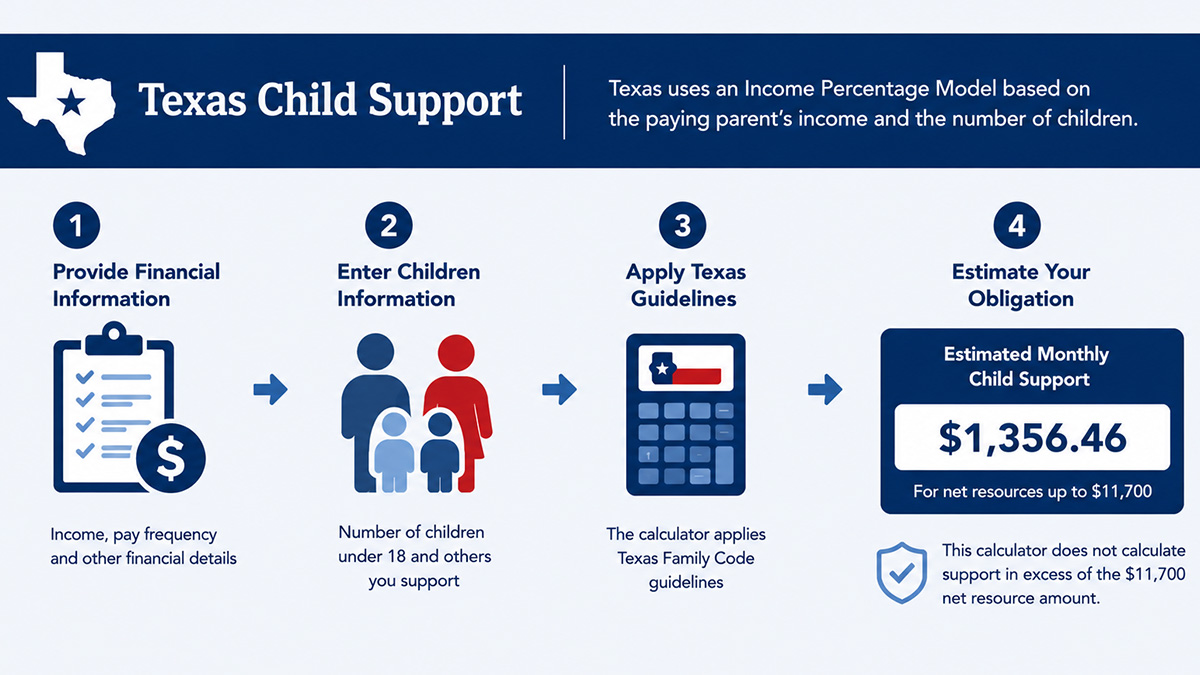
A Texas calculator (income percentage method) will produce results that differ from systems used in states such as Virginia, New Hampshire, or Illinois (income shares), even when income and custody arrangements are similar. Dr Lancaster says the only reliable way to estimate child support is to use an online calculator specific to your jurisdiction, whether that's the UK, Australia, or an American state. "Legislators seem to find all sorts of interesting ways to make the formula in their region different from everywhere else."