Best AI Agent Builders You Need to Try in 2026
AI agents have moved past the hype stage. In 2026, businesses are no longer asking if they should use AI agents, they are asking which agent builder fits their workflow best. Whether you run a marketing team, a support desk, or a full enterprise stack, the right platform can turn a simple prompt into a working digital employee that plans, reasons, and completes tasks on its own.
This guide breaks down the best AI agent builders worth trying this year, what makes each one useful, and how to pick a platform that actually matches your goals instead of chasing every new tool on the market.
What Is an AI Agent Builder?
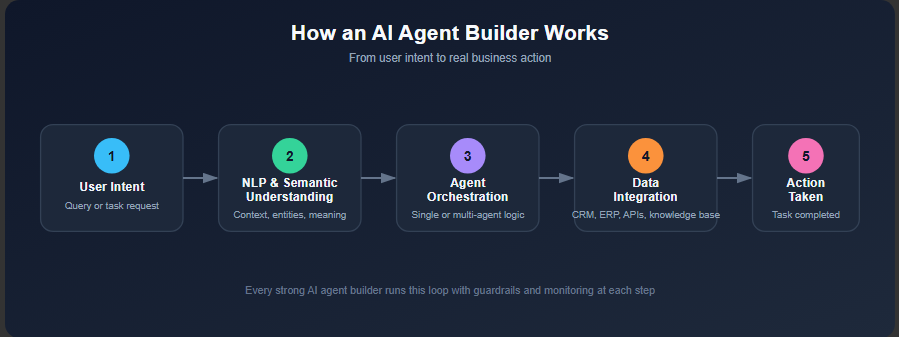
An AI agent builder is a platform that lets you design, train, and deploy autonomous agents without writing everything from scratch. These tools combine large language models (LLMs), natural language processing (NLP), semantic search, and workflow automation so an agent can understand intent, pull context from your data, and act on it, not just chat.
Good agent builders also support multi-agent orchestration, meaning several specialized agents (sales, support, research) can work together instead of one bot trying to do everything.
Why Choosing the Right Agent Builder Matters in 2026
Search behavior itself has changed. People are not just typing short queries into Google anymore, they are asking full questions to AI assistants and expecting direct answers. This is why brands are now optimizing content for SEO, AEO (answer engine optimization), GEO (generative engine optimization), and AIO (AI optimization) at the same time. An AI agent that understands long tail, conversational queries and responds with semantic accuracy gives your business a real edge in this shift, whether it is answering customer questions or pulling structured data for your team.
If your agent cannot understand context or intent correctly, it does not matter how advanced its interface looks. That is the real test of a good builder.
Best AI Agent Builders to Try in 2026
1. ZYNO AI Agent Development
ZYNO AI Agent Development, by Elite Mindz, stands out for teams that want enterprise grade agents rather than a generic chatbot wrapper. It focuses on building autonomous agents that act like digital employees, handling workflows, making decisions, and integrating directly with CRMs, ERPs, APIs, and internal knowledge bases.
What makes ZYNO worth trying:
- Full lifecycle development, from workflow mapping and agent architecture design to deployment and ongoing monitoring
- Support for single agent and multi-agent systems that collaborate across departments like sales, support, and finance
- Built-in guardrails, human-in-the-loop controls, and compliance-first design (GDPR, HIPAA, SOC 2 ready)
- Domain-specific agents already proven across healthcare, retail, finance, and logistics
- Agent-as-a-service options for businesses that want pre-trained agents instead of building from zero
For companies that need agents grounded in real business data with semantic understanding of internal documents and customer intent, rather than a surface-level demo bot, ZYNO AI Agent Development is one of the more complete options available in 2026.
2. LangChain / LangGraph
A developer favorite for building custom agent logic. LangGraph in particular has become popular for structuring multi-step reasoning and stateful agent workflows. It is flexible but requires actual coding skill, so it fits engineering teams more than non-technical users.
3. Microsoft Copilot Studio
Microsoft's low-code builder plugs directly into the Microsoft 365 ecosystem, making it a natural fit for enterprises already using Teams, Outlook, and Power Platform. It is strong for internal automation agents but less flexible outside the Microsoft stack.
4. CrewAI
CrewAI focuses purely on multi-agent collaboration, where you define "roles" for each agent and let them work as a coordinated crew. It has gained traction with teams experimenting with agent-to-agent task delegation.
5. Relevance AI
A no-code option built for marketing and operations teams that want to launch agents fast without deep technical setup. It works well for research agents and data enrichment tasks.
How to Pick the Right AI Agent Builder
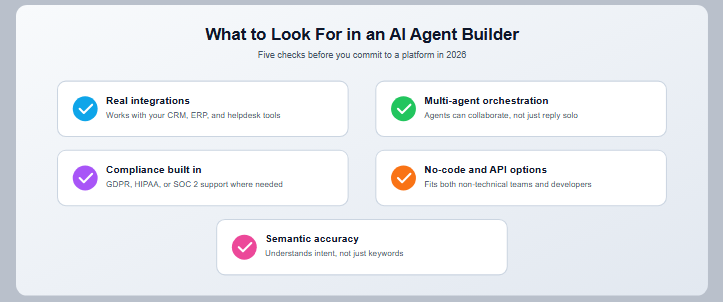
Match the tool to your intent, not the trend. A few things worth checking before you commit:
- Does it support real integrations with your existing tools (CRM, ERP, helpdesk)?
- Can it handle multi-agent orchestration if your workflow needs more than one agent?
- Does it offer compliance and security controls suited to your industry?
- Is there a no-code option if your team is not technical, or full API access if you need custom logic?
If you are also managing how your agents or content get discovered, it is worth pairing this with a proper task management setup so agent outputs stay organized, and tracking how your brand shows up across AI answers using tools covered in AI visibility tracking.
Final Thoughts
The best AI agent builder in 2026 is not the one with the flashiest demo, it is the one that understands your workflow, respects your data, and scales with your business without constant babysitting. Platforms like ZYNO AI Agent Development are built specifically for that enterprise-grade reliability, while tools like LangChain, CrewAI, and Copilot Studio serve more specific technical or ecosystem needs.
Whichever builder you choose, focus on semantic accuracy, real automation, and long term integration, not just how well it performs in a five-minute demo.