7 Best Virtual Assistant Companies in 2026 for Busy Executives
Busy executives rarely need help finding more work. They need help clearing the inbox, fixing calendar clashes, chasing invoices, and keeping follow-ups moving. A virtual assistant can take on those tasks, but the support model matters as much as the person you hire.
My top pick is Wing Assistant for its dedicated-assistant model, management support, and General VA pricing. Below, I compare it with six alternatives for different workloads and working styles. All prices are in USD and should be reconfirmed before signing.
Key Takeaways
- Wing Assistant is my top pick overall. Dedicated support, a Success Manager, and clearly priced General VA plans make it attractive for recurring admin.
- Prialto suits teams that prioritize continuity. Its model includes an engagement manager, backup support, and documented processes.
- Time etc fits lighter US-based workloads. Plans start at 10 monthly hours, with rollover listed from the 20-hour plan upward.
- Boldly targets executives seeking experienced support. Its 40-hour monthly minimum requires a larger commitment.
- Double, BELAY, and Zirtual serve different needs. Consider app-based delegation, specialist matching, or smaller monthly hour packages, respectively.
How I tested
This is a desk-based comparison, not a paid trial of all seven services. I assessed the provider-page details supplied for this review. The “My experience” sections explain my assessment of each model rather than claiming measured performance.
Management and oversight. I looked for a provider-side contact beyond the assistant, plus a process for handling an unsuitable match.
Pricing and commitments. I compared published plan figures, included hours, minimum commitments, and extra fees. Where usable product-page pricing wasn't available, I've written “contact sales” rather than estimating.
Coverage and time zones. I considered monthly capacity, business-hours restrictions, and whether assistants are US-based or available globally. Monthly hours aren't the same as continuous availability.
Security, scalability, and task fit. I considered provider-stated security practices, options for adding hours or roles, and suitability for inboxes, calendars, CRM updates, billing follow-up, and light customer support.
If you're also delegating support tickets, it's worth weighing AI customer support platforms alongside the assistant options below.
What is a managed virtual assistant service?
A managed virtual assistant service handles some combination of recruiting, matching, onboarding, and relationship support. Depending on the provider, you may work with a dedicated assistant, a manager, and backup support.
That's different from a freelancer marketplace, where you usually handle screening and management yourself. A managed service can reduce that workload, but you'll still need to set priorities, explain recurring tasks, and approve sensitive actions. The goal is less coordination, not zero involvement.
1. Wing Assistant
Wing Assistant pros
- Dedicated assistant backed by a Success Manager, giving you a clear provider-side contact.
- Wing handles matching, onboarding, and ongoing oversight.
- Published General VA plans include 80 or 160 hours per month.
- Global and US-based assistant options are described on the General VA page.
- Optional bilingual support is available for General VA arrangements.
- Wing handles replacement if the assistant match isn't working.
- Wing's site describes its security approach using SOC 2 and ISO 27001, with HIPAA compliance published on its healthcare pages.
Wing Assistant cons
- Pricing varies by role, so confirm rates for specialized work.
- Security and compliance statements come from Wing's site and weren't independently verified for this review.
- Very light workloads may not need the 80-hour part-time block.
My experience with Wing Assistant
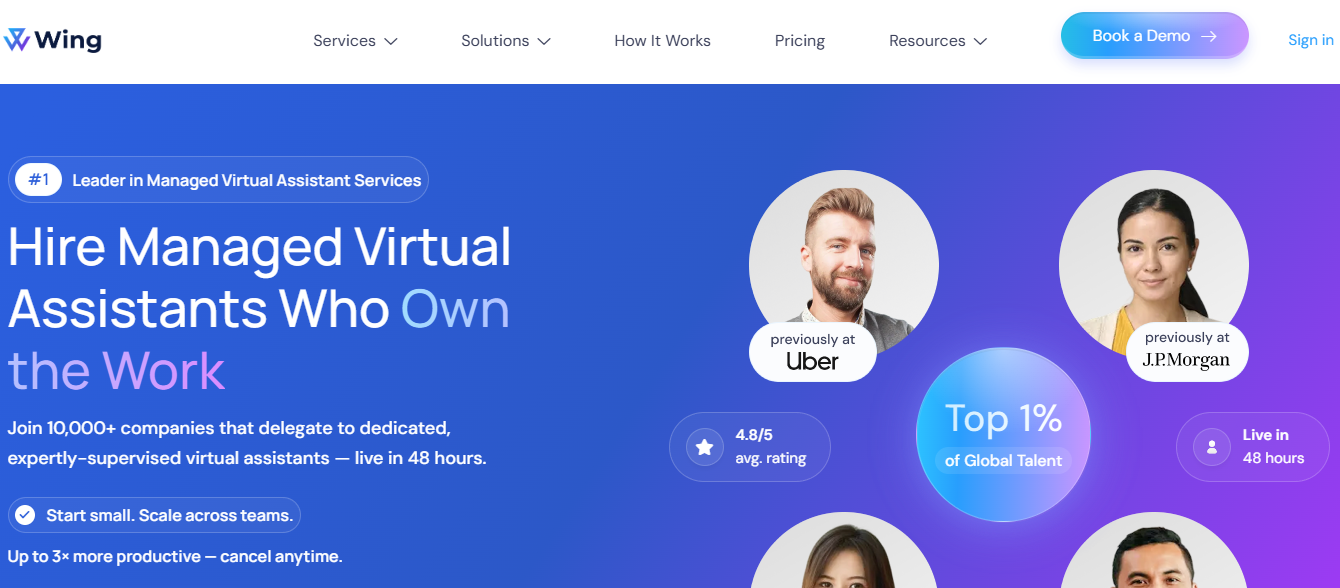
Wing is where I'd start for an executive with a steady backlog of recurring admin. What stands out is the combination of a dedicated assistant and provider-side management. You're choosing a support arrangement, not simply adding another person to supervise.
If you want one provider to handle matching, onboarding, oversight, and replacement, Wing's VA Assistant model gives you a dedicated assistant backed by a Success Manager. I like having that clear line of accountability. It's a practical setup for delegating inbox sorting, scheduling, follow-ups, and CRM updates with written instructions and approval rules.
The published General VA hours also make capacity easier to budget. Global, US-based, and bilingual options give you useful choices when discussing communication needs. I'd confirm the selected role and staffing arrangement in the quote rather than treat the baseline General VA figures as a universal rate card.
Security deserves its own check. Wing's site references SOC 2 and ISO 27001, with HIPAA compliance covered on its healthcare pages, but those statements aren't independent verification. If your assistant will handle sensitive information, request documentation relevant to your requirements before granting access.
Wing Assistant price
The General Virtual Assistant pricing supplied for this comparison lists USD 699/month for 80 hours and USD 999/month for 160 hours. That works out to approximately USD 8.74 and USD 6.24 per included hour, respectively.
That's compelling value for steady general admin, especially when you can use the larger allocation. These figures apply to the General VA role, not every specialized position or staffing configuration. Confirm the rate for your chosen role, working schedule, and assistant option before committing. The 160-hour allocation describes monthly capacity, not round-the-clock coverage.
Wing: General VA monthly plans80 hours: USD 699160 hours: USD 999General VA plan snapshot. Specialized roles have separate pricing.
2. Prialto
Prialto pros
- Flat-rate unit model, described as having no overage fees or hidden costs.
- Each unit includes 55 monthly hours; capacity grows by adding units.
- Engagement manager and backup assistant support provide continuity.
- Process documentation helps preserve working instructions.
- Standard coverage is 9 a.m. to 6 p.m., Monday through Friday, in US/UK time zones.
Prialto cons
- USD 250 setup fee, waived on a one-year agreement, plus a 90-day minimum per unit.
- Standard coverage excludes evenings, weekends, and holidays.
- Higher effective hourly cost than Wing's listed General VA plans.
My experience with Prialto
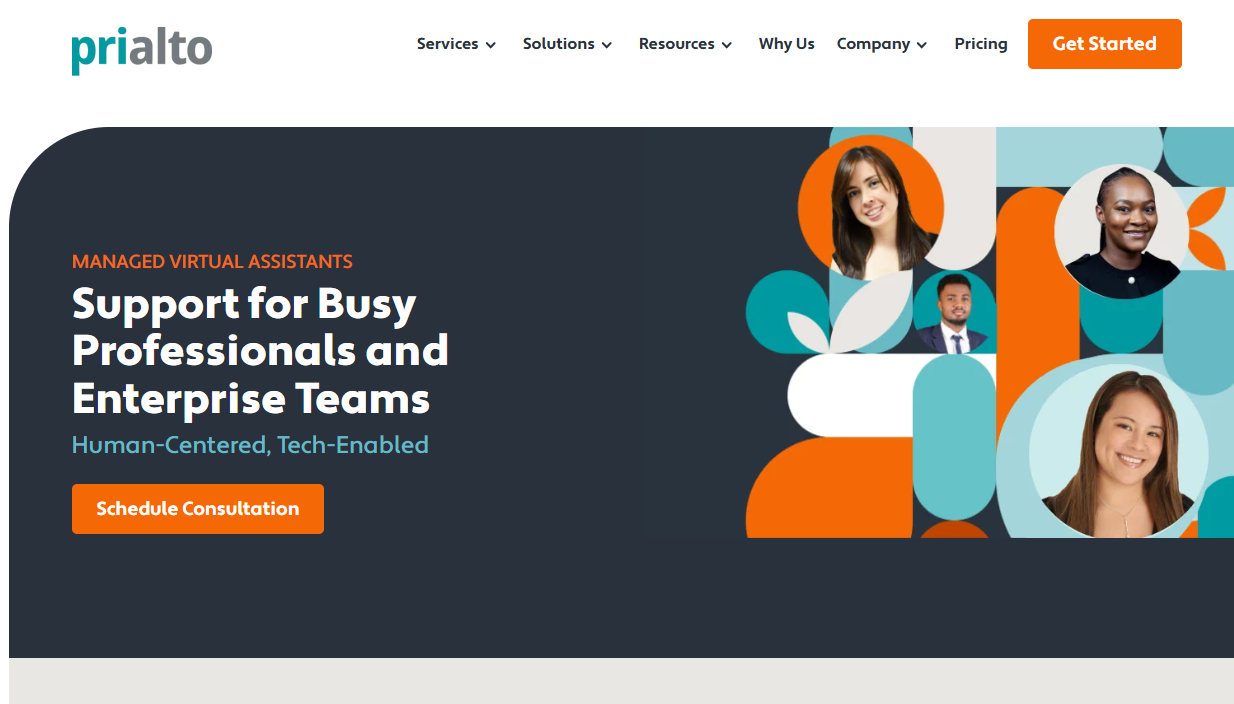
Prialto's appeal is predictability. A defined monthly unit makes it easier to plan capacity, while the engagement manager gives you someone to involve when priorities or processes change.
I particularly like the emphasis on backup support and documentation. Those features address a common problem: recurring work that depends entirely on one person's memory. They make Prialto worth considering when continuity matters more than the lowest hourly cost.
The commitment needs attention, though. I'd agree on the initial task list before accepting the 90-day minimum. I'd also confirm how sustained demand beyond one unit is handled, rather than reading “no overage fees” as unlimited capacity.
Prialto price
Prialto's pricing page lists a unit at USD 1,600/month for 55 hours, while the FAQ on that same page states flat pricing starting at USD 1,500/month, roughly USD 29.09 and USD 27.27 per included hour. Prialto's separate FAQ page also quotes USD 1,500. Because the figures conflict on Prialto's own site, treat the unit price as a range and confirm it directly. There's a USD 250 initial setup fee, waived with a one-year agreement, and a 90-day minimum per unit. Full-time coverage of 165 or more hours starts at USD 3,600/month.
Prialto: one service unit55 hoursUSD 1,60090 daysper monthper monthminimum termUnit pricing excludes the initial setup fee; confirm the applicable offer.
3. Time etc
Time etc pros
- Assistants are 100% US-based, according to its pricing page.
- Published tiers make monthly costs straightforward to compare.
- Unused hours roll over to the next month on the 20-hour plan and above.
- The 10-hour entry plan suits a smaller initial workload.
Time etc cons
- Listed hourly rates of USD 36 to USD 39 exceed Wing's General VA rates.
- Better suited to ongoing admin than specialized staffing.
- Business-hours support isn't round-the-clock coverage.
My experience with Time etc
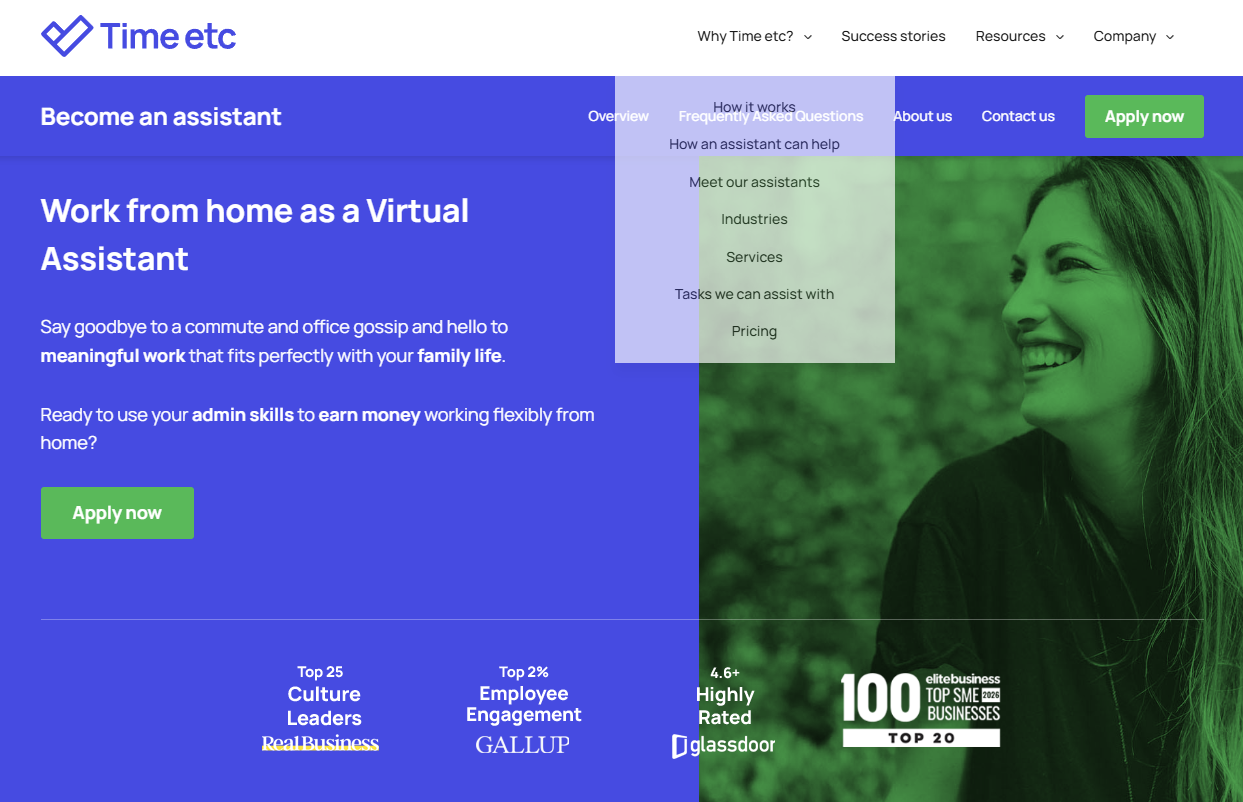
I'd shortlist Time etc for someone who wants US-based help without buying a large monthly allocation. The tiers are easy to understand, and rollover is useful when administrative demand changes from month to month.
It fits a manageable list of scheduling, inbox, research, and bookkeeping-preparation tasks. I'd still check rollover conditions and agree on working hours before deciding how much capacity to buy.
The trade-off is hourly cost. If location and a small commitment matter most, the model makes sense. If you're open to global support and have substantial recurring work, Wing's larger General VA plans offer more hours for the budget.
Time etc price
Plans are USD 390/month for 10 hours, USD 760 for 20 hours, USD 1,480 for 40 hours, and USD 2,160 for 60 hours. Effective hourly rates range from USD 39 to USD 36. Rollover is listed on the 20-hour plan and above, and there is no setup fee.
Time etc: monthly hours and pricing10 hours: USD 39020 hours: USD 76040 hours: USD 1,48060 hours: USD 2,160Monthly capacity increases across four published tiers.
4. Boldly
Boldly pros
- Experienced assistants based in North America or Europe, with W2 employment for US staff.
- Backup coverage and a satisfaction guarantee.
- Plan pricing published on its main pricing page, with separate higher rates for New York State.
- A separate published hourly rate for specialist tasks.
Boldly cons
- 40-hour monthly minimum per assistant.
- The entry plan requires USD 2,600/month, or USD 2,678 under New York pricing.
- Specialist tasks are billed separately at USD 79/hour.
My experience with Boldly
Boldly's positioning makes sense for executives who want experienced assistance rather than a low-cost general-admin arrangement. The employment model is worth discussing with your own HR or legal team if worker classification affects your buying decision.
I'd consider it for a demanding calendar and correspondence workload where experience matters. Backup coverage is useful, but I'd ask how handovers work. The main constraint is the commitment: 40 monthly hours is substantial if you haven't yet established what you'll delegate.
Boldly price
Boldly's pricing page lists USD 2,600/month for 40 hours, USD 3,900 for 60 hours, USD 5,200 for 80 hours, and USD 6,500 for 100 hours, a flat USD 65 per included hour at every tier. Those prices assume payment by ACH direct debit, and card payments add a 2.9% processing fee. A separate page for New York State lists higher figures, starting at USD 2,678/month for 40 hours. Specialist tasks are USD 79/hour. Plans above 100 hours are quoted on request.
Boldly: pricing snapshot40 hours/month minimumEntry plan: USD 2,600/month (USD 2,678 in New York)Specialist tasks: USD 79/hour, billed separatelyPrices assume ACH payment; card payments add 2.9%.

5. Double
Double pros
- App-based workflow combining a human executive assistant with AI support.
- Published tiers, with additional hours available to purchase on any plan.
- Hours can be shared across multiple executives from the Grow tier upward, or with one teammate on Starter.
- The onboarding fee is refunded after three months.
Double cons
- USD 300 onboarding fee is payable up front.
- Per-hour cost falls only as you move up tiers, from roughly USD 55 on Starter to USD 47 on Scale.
- The largest published plan covers 60 hours a month, so heavier workloads need a custom arrangement.
- Availability is limited to the US, Canada, and France.
My experience with Double
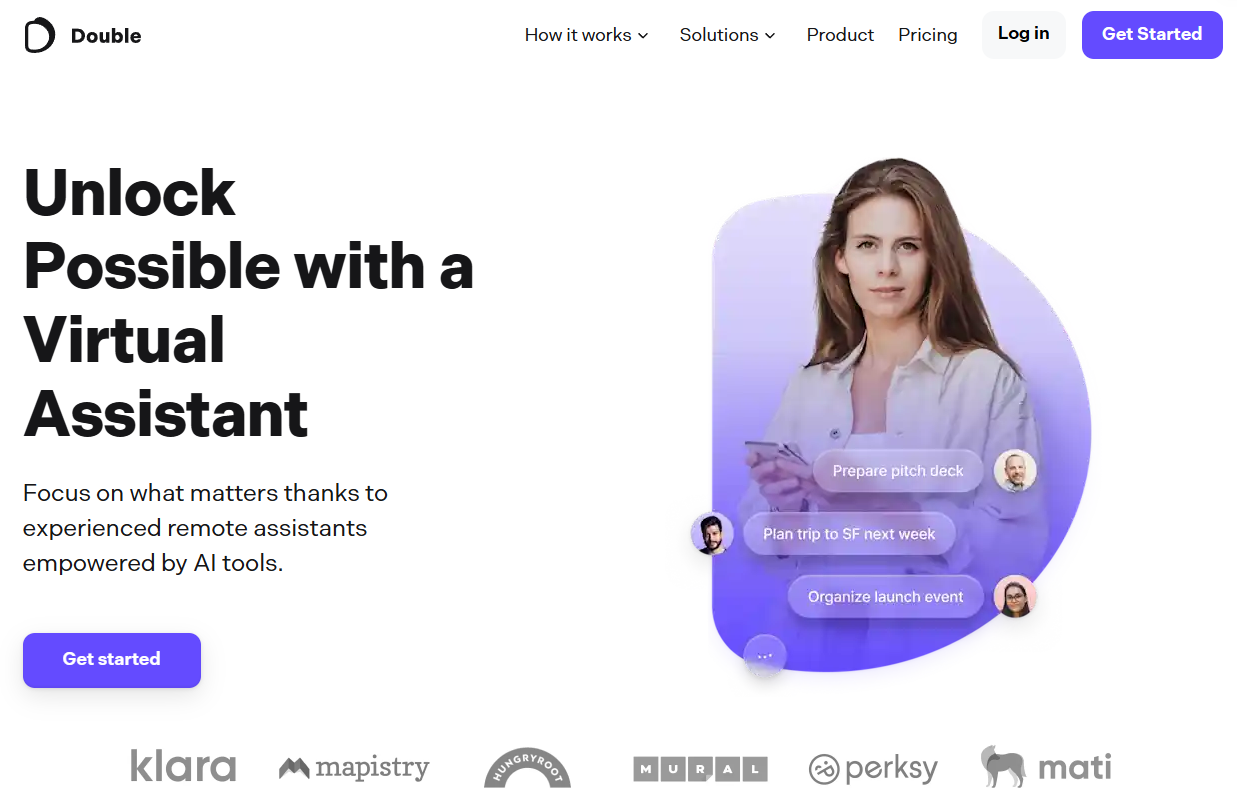
Double looks suited to leaders who prefer app-based delegation. Sharing hours across executives is practical when several people need modest amounts of support rather than separate large allocations.
I'd focus less on the AI label and more on whether the workflow matches how you assign and review tasks. The main budgeting issue is extra hours: a small tier can become less predictable if you regularly exceed it. Weekend availability also needs to match your expectations.
Double price
Starter is USD 549/month for 10 hours; Grow is USD 999 for 20 hours; Build is USD 1,899 for 40 hours; and Scale is USD 2,799 for 60 hours. That runs from about USD 54.90 to USD 46.65 per included hour. Additional hours can be purchased on any plan. Double's site describes a USD 300 onboarding fee refunded if you stay past three months, though the current pricing page doesn't list it, so confirm it on the consultation call.
6. BELAY
BELAY pros
- US-based assistants selected through its hiring process.
- A custom monthly quote scoped to your hours and specialization.
- Assistant specialties beyond general admin.
- Provider-side relationship management.
BELAY cons
- Detailed pricing requires a sales consultation.
- Budget comparisons depend on obtaining a scoped quote.
- Role-specific scope needs confirmation before signing.
My experience with BELAY
BELAY takes a relationship-led approach: a US-based assistant supported by a provider-side contact. I'd consider it when the role requires a particular specialty rather than a broad list of general tasks.
The consultation step makes quick comparisons harder. I'd bring the same task list and expected monthly workload used for the other providers, then request a written breakdown of scope, hours, and coverage. That matters more than comparing an isolated starting price.
BELAY price
Contact sales. The supplied starting figure came from a resource page rather than a cited primary product pricing page, so it isn't used here. Request a quote covering your role, monthly hours, working schedule, and any additional fees.
7. Zirtual
Zirtual pros
- Published plans covering 12 to 45 monthly hours.
- US-based, college-educated assistants.
- Two-hour response targets during business hours in your US time zone.
- Dedicated assistant reachable by phone, SMS, and email.
Zirtual cons
- Listed packages cover only 12 to 45 monthly hours.
- Monthly costs rise as capacity increases.
- Less suitable for workloads approaching full-time support.
My experience with Zirtual
Zirtual is a straightforward option for a solo executive with a predictable, lighter workload. Familiar communication channels can keep delegation simple, especially if you don't want an app-centered process.
The response target is useful, but it isn't a promise that every task will be completed within two hours. I'd clarify turnaround expectations for research or multi-step assignments. If your workload is already approaching the 45-hour ceiling, compare that capacity with Wing's larger General VA allocations.
Zirtual price
Entrepreneur is USD 599/month for 12 hours, Grow is USD 899 for 20 hours, Small Business is USD 1,199 for 30 hours, and Team is USD 1,699 for 45 hours. The stated two-hour response target applies during business hours in your US time zone. Zirtual's pricing page says there is no setup fee, but its signup pages show a USD 399 setup fee, so confirm this before signing.
Conclusion
Wing Assistant is my top pick for busy executives and small teams with recurring administrative work. Its dedicated assistant, Success Manager, and published General VA hour allocations make the offering easy to understand. The larger plan offers particularly attractive value when you have enough general-admin work to use it. Confirm specialized-role pricing and the working schedule before signing.
For narrower needs, I'd shortlist Prialto for team-backed continuity, Time etc for smaller US-based allocations, and Boldly for experienced executive support with a larger minimum commitment. Double, BELAY, and Zirtual remain worth considering when their workflow, specialization, or capacity better matches your requirements.
Before choosing, write down three recurring tasks, their approximate monthly hours, and any access or approval limits. Agree on responsibilities and review points during onboarding, while respecting the provider's minimum term. Add capacity when the arrangement is working, not simply because a larger package has a lower hourly rate.